



How to Build a 60-Card Pokémon TCG Deck: Ratios and Consistency
Reviewed October 20, 2026 · Tournament data as of October 18, 2026
A 60-card Pokémon TCG deck is the pile you shuffle up for a Standard game, and its ratios are how you split those 60 slots between Pokémon, Trainer and Energy cards.
CardForge looked at 7,267 tournament decklists from 85 events over a 51-day window ending in October 2026. The typical top list runs 21 Pokémon, 31 Trainers and 9 Energy. Trainers are the biggest group because they're the cards that fix a bad hand. So if your homebrew keeps bricking (drawing a hand where you can't do anything useful), the fix is almost always in the Trainers, and specifically in how much draw and search you run. That's what players mean by consistency: how reliably your deck does its main thing, game after game.
Start with what your deck needs to do
Before you count anything, answer these on paper:
- Which attack actually wins you games, and what Energy does it cost?
- What has to be in play for that attack to work: an evolved attacker, support Pokémon with Abilities, a Tool attached?
- How early do you need it? A deck that wants a big evolved attacker ready fast builds differently from one that can take its time.
Every ratio in a good list answers one of those questions. That's why top decks look so different from each other. Among the most-played decks right now, the median number of Basic Pokémon runs from 11 to 20 and the median Energy count from 5 to 14. Same 60 slots, very different jobs.
Here are two real examples. One popular Mega deck builds almost entirely from Basic Pokémon: its median list runs 20 Basics and 14 Energy, because its attackers go straight into play and it attaches Energy by hand every turn. A deck built around the Stage 2 Alakazam runs a median of 6 Energy, because Alakazam's "Powerful Hand" costs a single Psychic Energy and gets its damage from the cards in your hand. Neither list is wrong. They're answering different questions.
So don't open with "how many Energy should I play?" Start with "what does my attacker need, and by when?" The numbers fall out of that.
The 60-card skeleton
Every deck is built from three card types.
Pokémon
A Basic Pokémon can go straight from your hand onto your Bench. A Stage 1 evolves from one specific Basic, and a Stage 2 evolves from one specific Stage 1, so you need the whole line in your deck. Unless specified, you can't evolve a Pokémon on the turn you played it or on your first turn of the game.
Trainers
There are four kinds. A Supporter is a powerful effect you can play only once per turn, like drawing a fresh hand (and the player going first can't play one on their first turn). An Item has no per-turn limit, so you can chain several. A Tool attaches to one of your Pokémon, normally one per Pokémon. A Stadium stays in play and affects both players, and a new one replaces whatever Stadium is already there.
Energy
Energy pays for attacks. Basic Energy is the only card you can run more than 4 copies of.
What tournament lists look like
| Card type | Typical top list | Range of medians across top decks |
|---|---|---|
| Pokémon | 21 | 17 to 22 |
| Basic Pokémon | 13 | 11 to 20 |
| Trainers | 31 | 25 to 35 |
| Supporters | 10 | 8 to 12 |
| Items | 17 | 12 to 19 |
| Stadiums | 3 | |
| Tools | 1 | |
| Energy | 9 | 5 to 14 |
The typical column is an average of each top deck's median, weighted by how many lists it has, so it won't add up to exactly 60. Use it as a sanity check.
Treat the ranges as boundaries. The Pokémon count barely moves (17 to 22) because every deck needs a similar amount of board. The Energy range is huge (5 to 14) because it depends almost entirely on the attacks. If your list sits outside a range, you should be able to explain why in one sentence. If you can't, that's usually the part of the list that's broken.
Consistency: draw, search and recovery
Your opening hand is seven random cards. Trainers are how you turn that random hand into the specific cards your plan needs, and that's why they fill most of a 60-card deck. Think of them by role. The card that fills each role will change when sets rotate, but the roles won't.
Draw Supporters
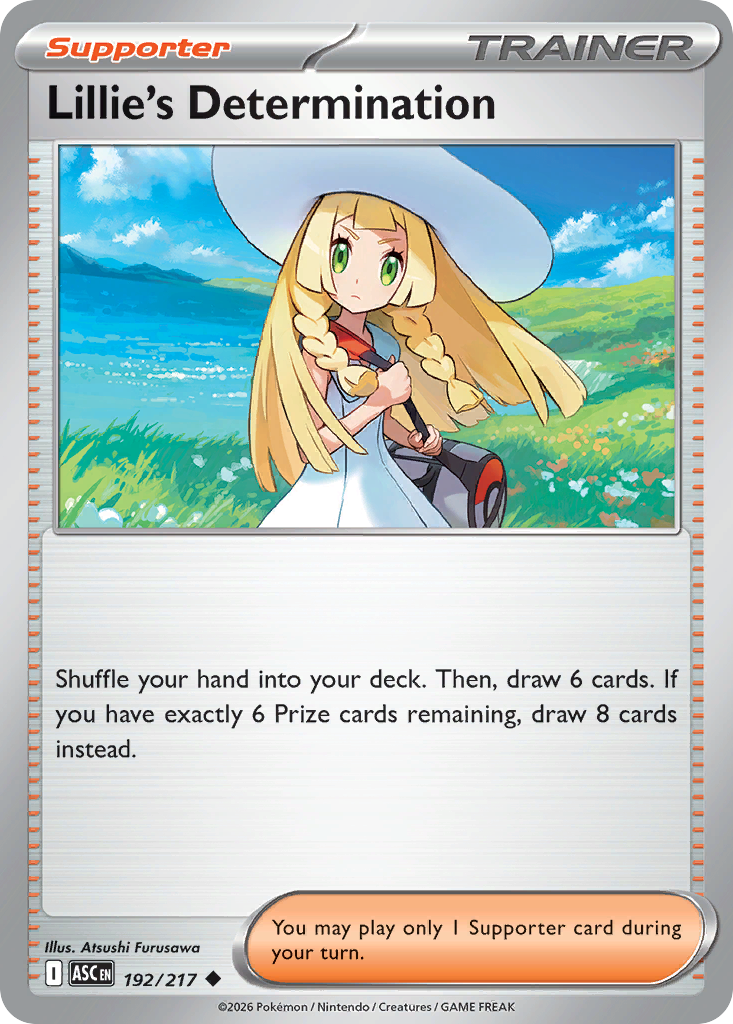
These replace a bad hand with a new one. Right now the big one is Lillie's Determination: you shuffle your hand into your deck and draw 6 cards, or 8 if you still have all 6 Prize cards left. It shows up in 83.8% of decks at an average of 3.8 copies, which means nearly everyone plays the full four. Judge (in 39.5% of decks) makes both players shuffle their hands in and draw 4, so it's a draw card that also messes up your opponent's hand.
Pokémon search Items
These grab a specific Pokémon from your deck. Since they're Items, you can play several in one turn. Today the standard trio is:
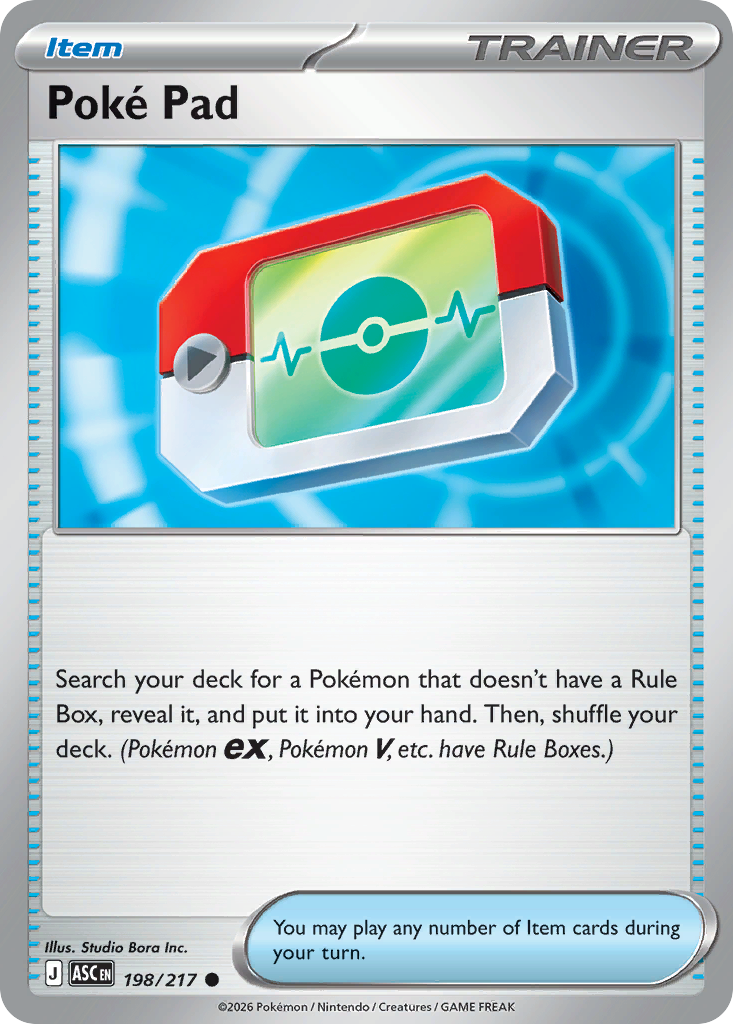
- Poké Pad (84% of decks, 3.5 copies) finds any Pokémon without a Rule Box. A Rule Box is the extra rules text on cards like Pokémon ex, which also give up extra Prize cards when Knocked Out.
- Ultra Ball (83.3%, 3.2 copies) finds any Pokémon, but you have to discard 2 other cards from your hand.
- Buddy-Buddy Poffin (65.3%, 3.6 copies) puts up to 2 Basic Pokémon with 70 HP or less straight onto your Bench.
Count each search Item as a partial extra copy of every Pokémon it can find. A deck with three copies of its attacker and a stack of search Items finds that attacker far more often than the raw copy count suggests.
Draw and search on Pokémon
Some Pokémon are in the deck for their Abilities, not their attacks. Meowth ex's "Last-Ditch Catch" searches your deck for a Supporter when you play it to the Bench, and Fezandipiti ex's "Flip the Script" draws 3 cards if one of your Pokémon was Knocked Out on your opponent's last turn. Both are ex, so each gives up 2 Prize cards when Knocked Out. That's the price of the draw.
Recovery
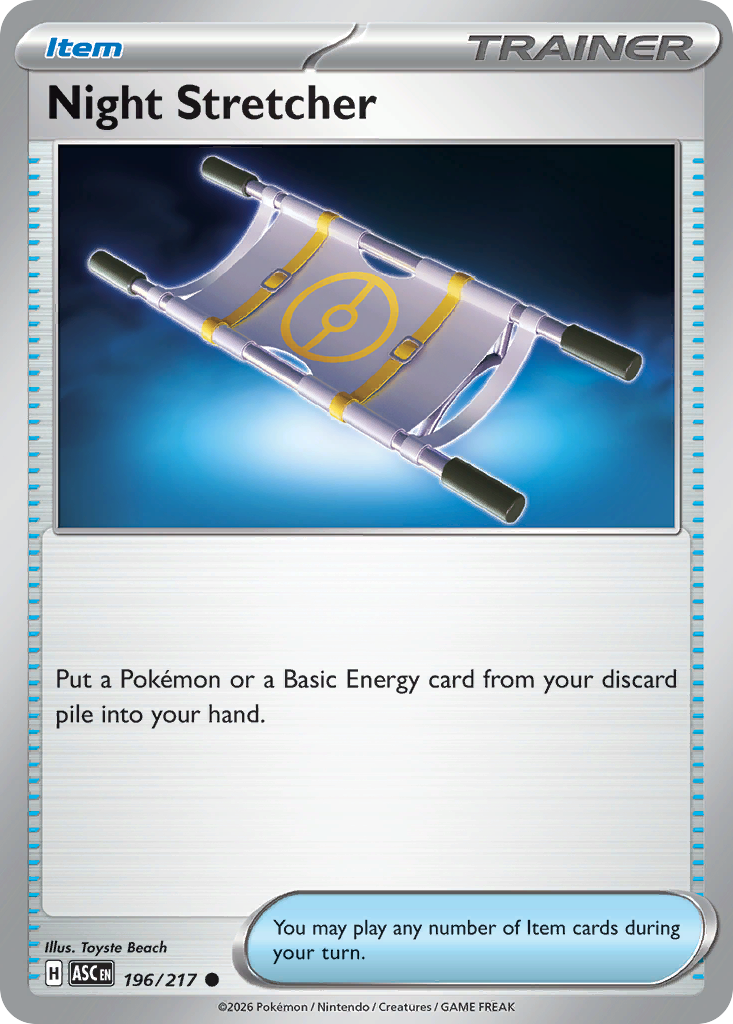
Recovery cards bring things back from your discard pile. Night Stretcher puts a Pokémon or a Basic Energy from your discard pile into your hand, and it's in 86.8% of decks at 2.1 copies. Recovery covers the cards you lose to a Knock Out or throw away to pay for Ultra Ball, so your deck doesn't run dry halfway through the game.
Basics, evolution lines and mulligans
If your opening seven has no Basic Pokémon, you have to mulligan: reveal the hand, shuffle it back in and draw a new seven, and your opponent gets a bonus card. More Basics means fewer mulligans. Here are the exact odds of a mulligan by Basic count:
| Basics in deck | Mulligan chance |
|---|---|
| 8 | 34.6% |
| 10 | 25.9% |
| 12 | 19.1% |
| 14 | 13.9% |
| 16 | 9.9% |
The typical top list runs 13 Basics, and the range across top decks is 11 to 20. Evolution decks sit at the low end because their Stage 1 and Stage 2 cards take up Pokémon slots. Basic-only decks sit high almost by default. Going from 8 to 12 Basics cuts your mulligan rate from 34.6% to 19.1%, and that's often the cheapest consistency fix a new deck can make. And Buddy-Buddy Poffin style Items help even more, because they turn one Basic in hand into a full Bench.
Line shapes follow the plan
Players write evolution lines as Basic-Stage 1-Stage 2 counts. The top decks don't share one shape:
- Dreepy, Drakloak, Dragapult ex: 4-4-3. Dragapult ex is the main attacker, and Drakloak's "Recon Directive" digs a card every turn, so the deck wants several Drakloak in play.
- Abra, Kadabra, Alakazam: 4-4-3 (3.9, 3.9, 3.1 on average). Kadabra's "Psychic Draw" draws 2 cards when you evolve into it, so it pays to evolve the slow way through the thick middle.
- Beldum, Metang, Metagross: 4-4-1 (3.9, 4, 1.4). Metang's "Metal Maker" is the engine, so the Stage 1 is the thick part and Metagross is a light finisher.
- Duskull, Dusclops, Dusknoir: 2-2-1 (2.1, 1.9, 1.3). It's a second line supporting a different main attacker, and Duskull's "Come and Get You" puts up to 3 Duskull from your discard pile onto the Bench.
- Torchic, Combusken, Blaziken ex: 2-1-2. Every list of this deck runs Rare Candy (2.4 copies on average), so the Stage 1 barely matters.
The rule underneath: put your copies where the card you need most sits. Your main attacker's line is thick. Support lines can be thin.

Rare Candy
Rare Candy evolves a Basic straight into its Stage 2, skipping the Stage 1. You can't use it on your first turn or on a Basic that was put into play that turn. It's in 26.5% of decks at 2.7 copies, almost all of them Stage 2 decks. If your Stage 1 does nothing useful, Candy lets you run fewer of them. If your Stage 1 has an Ability you want (like Kadabra or Metang), keep that middle stage thick.
Energy: count what your attacks actually need
Most beginners pick an Energy number from a gut feeling. Work it out from the attacks instead.
- Look at your main attack's cost. Count the Energy symbols and note any specific types.
- Count how many times you'll need to pay it in a game. If every new attacker needs fresh Energy attached by hand, you need more.
- Subtract for acceleration, meaning anything that attaches Energy besides your one manual attachment per turn.
- Subtract for recovery that gets Energy back from the discard pile.
The typical top list runs 9 Energy, and the medians range from 5 to 14.
Dragapult ex's "Phantom Dive" costs just a Fire and a Psychic Energy, and the three top decks built around it all have a median of 8 Energy. A cheap attack plus Night Stretcher to pull back Basic Energy keeps the count low. The Basic-heavy Mega deck from earlier sits at 14 because it pays for attacks by hand. The lowest median in the data is 5.
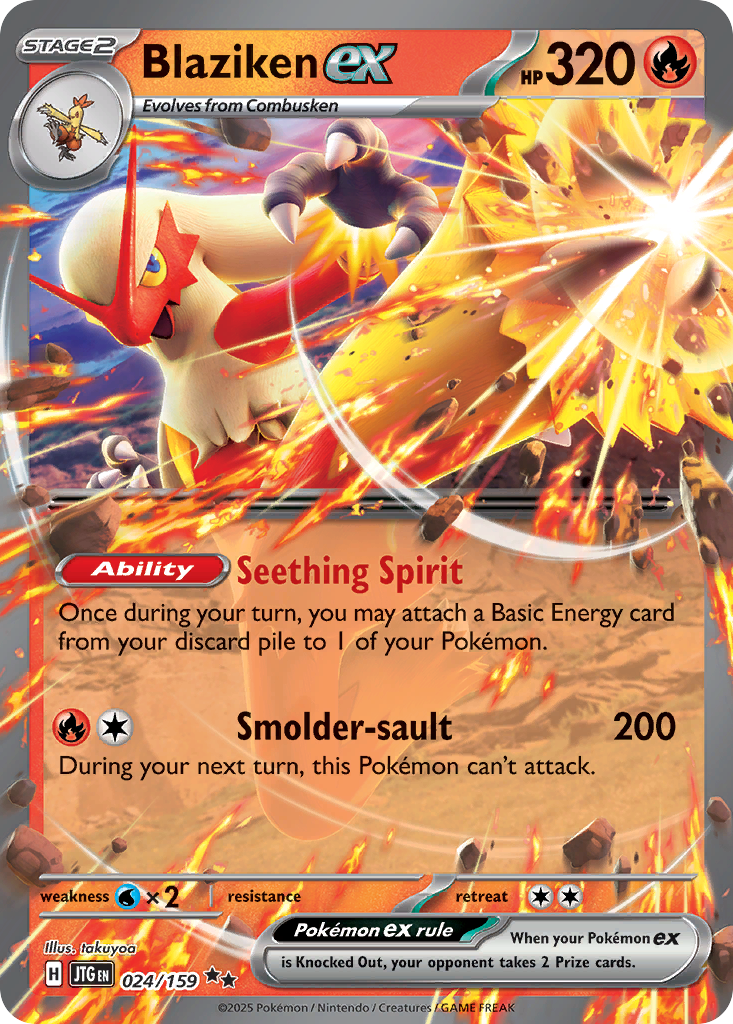
Recovery Abilities cut your count. Blaziken ex's "Seething Spirit" attaches a Basic Energy from your discard pile to one of your Pokémon once a turn, so Energy you've spent comes back instead of being gone for good.

Acceleration can push the count the other way. Metagross's "Metallic Hammer" costs three Metal and one Colorless Energy, and it can discard 3 Metal Energy for 150 more damage. Metang's "Metal Maker" looks at the top 4 cards of your deck and attaches any Basic Metal Energy it finds there. An Ability like that only hits if there's Energy to find, so a deck built on it wants enough Metal Energy for the Ability to land. Every Energy you add is one fewer Trainer, though, so test where the balance sits for your deck.
4-ofs, 1-ofs and the maths of consistency
A 4-of is a card you run four copies of, the maximum for anything except Basic Energy. A 1-of is a single copy. Here are the exact odds of seeing at least one copy:
| Copies in deck | In your opening 7 | By your first draw |
|---|---|---|
| 1 | 11.7% | 13.3% |
| 2 | 22.1% | 25.1% |
| 3 | 31.5% | 35.4% |
| 4 | 39.9% | 44.5% |
Even a 4-of is in your opening hand less than half the time. That's exactly why draw and search matter so much: they're how you reach the card the other times.
Prize cards matter too. At the start of the game you set aside 6 cards face down as Prizes, and you take one each time you Knock Out a Pokémon (two for a Pokémon ex, three for a MEGA Pokémon ex). A card stuck in your Prizes is "prized", and you can't use it until you take it. A single copy is prized 10% of the time. With a 4-of, at least one copy is prized 35.1% of the time, but you have three others. Both copies of a 2-of end up prized only 0.8% of the time.
The copy-count pattern in real lists
Across 320 Top 64 decklists from five recent Regionals, the average list had 25.5 different cards. Of all the card entries:
- 37.1% were 1-ofs
- 22% were 2-ofs
- 15.9% were 3-ofs
- 23.8% were 4-ofs
- 1.2% were Basic Energy above four copies
The pattern is a solid core of 4-ofs (draw Supporters, search Items, the main line) plus a lot of single-copy cards for specific jobs.
When a 1-of makes sense
A 1-of earns its slot when at least one of these is true:
- You only need it once a game. Fezandipiti ex averages exactly 1 copy.
- It only works late. Special Red Card can only be played when your opponent has 3 or fewer Prize cards left, so you don't want it clogging your opening hand. It averages 1.1 copies.
- You can search for it. Meowth ex's "Last-Ditch Catch" can fetch a single-copy Supporter, and Poké Pad can find a single Stage 2 that has no Rule Box.
- It's a tech: a card you add for one matchup or situation.
If you need a card every single game and nothing can search it, don't run it as a 1-of. You'll lose it to the Prizes 10% of the time, and you'll miss it in your opening hand far more often than that.
Building any deck, step by step
Here's an order that works for any attacker, including one nobody's built around yet.
- Pick your main attacker. Write down its stage, its attack cost and how much damage it does.
- Build its line. A Stage 2 main attacker usually wants a thick line, like 4-4-3. Decide now whether Rare Candy is part of the plan, because that changes how many Stage 1 cards you need.
- Add support Pokémon only when each one has a specific job: drawing cards, searching, accelerating Energy. If it's an ex, remember it gives up 2 Prizes.
- Add your draw Supporters. Most decks run four copies of their main draw Supporter, then fill the rest of the roughly 10 Supporter slots with things like Boss's Orders.
- Add search Items for your Pokémon, and Buddy-Buddy Poffin style cards if your Basics are small enough.
- Count Energy from your attack costs, then subtract acceleration and recovery.
- Add recovery so you can get Pokémon and Energy back.
- Spend whatever's left on techs and Stadiums.
- Check each card type against the ranges in the skeleton table. Check your Basic count against the mulligan table. Count to exactly 60.
- Play games.
Testing and adjusting
Play a batch of games and, after every loss, write down one sentence on why. Not "bad luck": the actual reason. Patterns show up quickly, and each one points to a specific fix.
You brick early
If you mulligan a lot, add Basics (see the mulligan table). If you have Basics but no plays, add a draw Supporter or a search Item. Cut a tech to make room, because early consistency wins more games than a card for one matchup.
You run out of Energy
Go back to the Energy math. Either the count's too low for how often you pay attack costs, or you need recovery like Night Stretcher to get Basic Energy back from the discard pile.
You're drowning in Energy
If your hands keep filling up with Energy you can't use, cut one or two and replace them with draw or search.
You can't find your attacker
Add search Items, thicken the line, or add Rare Candy if it's a Stage 2. If the attacker keeps getting prized, a fourth copy or more recovery fixes that.
You set up fine and still lose late
That's a game-plan problem more than a consistency one. Look at the late-game role cards: something like Boss's Orders to reach a specific target, or Special Red Card to wreck your opponent's hand when they're close to winning.
Change one thing at a time, then play more games. If you swap five cards at once, you won't know which one fixed the problem.
Common beginner mistakes
Too many different cards
The average top list has 25.5 different cards, and nearly a quarter of its entries are 4-ofs. Beginner lists often have 35 or more one- and two-ofs, and every game plays differently because the deck never draws the same thing twice. Pick your core and run it heavily.
Too few draw Supporters
The range across top decks is 8 to 12 Supporters, and the main draw Supporter is almost always a 4-of. If you're running two copies of three different draw Supporters, you're giving up consistency for variety you don't need.
Too much Energy
New players often run 15 or more Energy "to be safe." The typical list runs 9, and even the most Energy-hungry top deck has a median of 14. Every extra Energy is a draw or search card you don't have.
Thin lines
A 1-1-1 Stage 2 line almost never comes together. If one piece gets prized or Knocked Out, the whole plan is gone. The top decks' main attacking lines look like 4-4-3, and even support lines run at least 2 Basics.
Copying a list without understanding it
Tournament lists are tuned for a field you might not be facing, and some of their 1-ofs only make sense against specific opponents. If you can't say why each card is there, you won't know what to change when the deck starts losing. Build from your own plan, then use the ranges in this guide to check your numbers.
FAQ
How many Energy cards should a Pokémon TCG deck have?
Work it out from your attacks' costs, then subtract for acceleration and Energy recovery. The typical top tournament list runs 9 Energy, and the medians across top decks range from 5 to 14. Decks with cheap attacks or Abilities that reuse Energy sit low. Decks that attach every Energy by hand sit high.
How many Basic Pokémon do I need to avoid mulligans?
The typical top list runs 13 Basics. With 8 Basics you'll mulligan 34.6% of the time, with 12 it's 19.1%, and with 16 it's 9.9%. Evolution decks usually run fewer because their Stage 1 and Stage 2 cards take up Pokémon slots, which is why they lean on search Items to find Basics.
How many Supporters and Items should I run?
The typical top list runs 10 Supporters and 17 Items. Across top decks the Supporter median ranges from 8 to 12 and the Item median from 12 to 19. Remember that some Supporters, like Boss's Orders, don't draw cards, so leave enough room for your main draw Supporter at four copies.
What are the odds of drawing a 4-of in my opening hand?
With four copies in a 60-card deck, you'll have at least one in your opening 7 cards 39.9% of the time, and 44.5% of the time by your first draw. With a single copy it's just 11.7% in the opening hand. That's why decks run draw Supporters and search Items to reach the cards they need.
How often does a card get stuck in my Prize cards?
A single-copy card is prized 10% of the time. With a 4-of, at least one copy is prized 35.1% of the time, though you still have the others. Both copies of a 2-of end up prized only 0.8% of the time, so a second copy is cheap insurance for a card you can't afford to lose.
More guides
- Dudunsparce Card Review: Run Away Draw in Standard · Card review
- 1st Place Alakazam Dusknoir, Regional Frankfurt: Decklist Profile · Decklist profile
- Mega Kangaskhan Slowking Deck Guide (Standard) · Archetype guide
- Mega Lopunny Dusknoir: 7th Place Regional Brisbane List · Decklist profile