



Hydrapple Teal Mask Ogerpon Deck Guide: Meta Analysis
Reviewed September 30, 2026 · Tournament data as of September 29, 2026
Hydrapple Teal Mask Ogerpon is a Grass energy acceleration deck. It stacks Basic Grass Energy across the board with Ability attachments, then hits hard with Teal Mask Ogerpon ex, Hydrapple ex and Tapu Bulu.
In the current window it ranks 11th in Standard, with 210 decklists (2.9% usage) and a 53.2% average win rate. It is also trending up: usage is up 0.5 and win rate up 1.5, and its best finish is a 1st place. Its matchup spread is lopsided, though. It beats most of the Mega Kangaskhan decks and N's Zoroark comfortably, and it loses to the most played deck in the format, Dragapult Munkidori, at 38.5% over 117 games.
How it wins
The deck gets more Energy onto the board in one turn than almost anything else in the format. It has three attachment sources: your manual attachment for the turn, "Teal Dance" on each Teal Mask Ogerpon ex, and "Ripening Charge" on each Hydrapple ex. Meganium's "Wild Growth" makes every Basic Grass Energy provide two Grass Energy, so each card you attach counts double for attack costs.
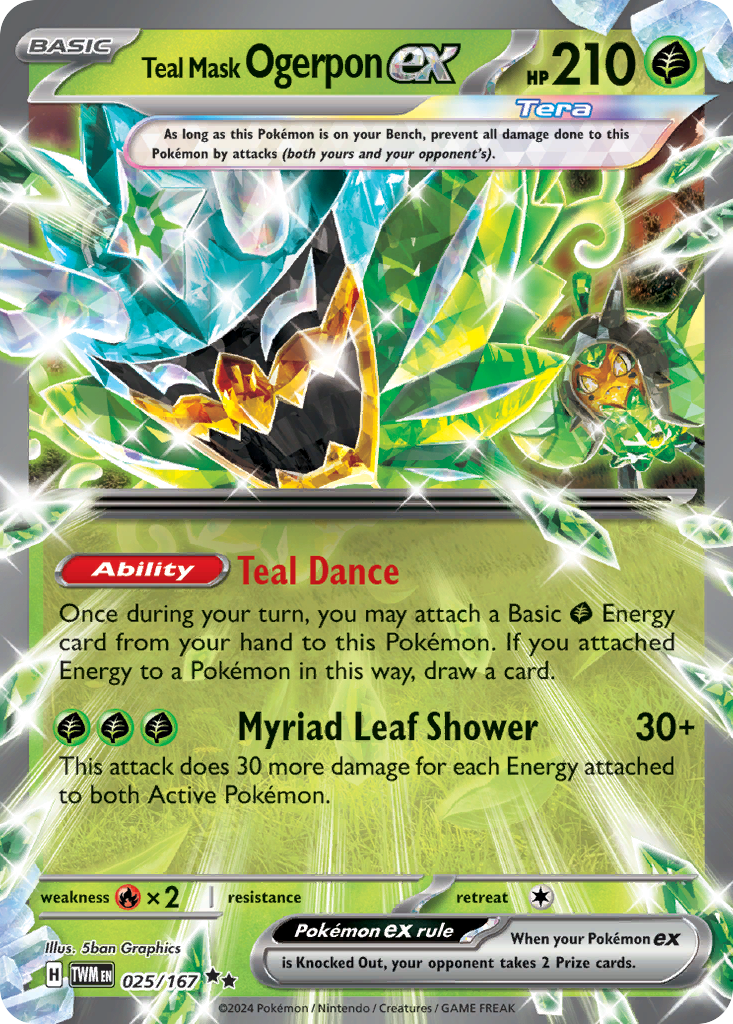
Teal Mask Ogerpon ex is both the engine and a considerable main attacker. "Teal Dance" attaches a Basic Grass Energy from hand to itself and draws a card. "Myriad Leaf Shower" does 30 plus 30 for each Energy attached to both Active Pokémon, so the damage goes up as you load Ogerpon and goes up again against opponents who load their own Active. As long as Ogerpon sits on your Bench, its Tera rule prevents all damage done to it by attacks. That makes benched Ogerpon a safe place to store Energy until you need it.
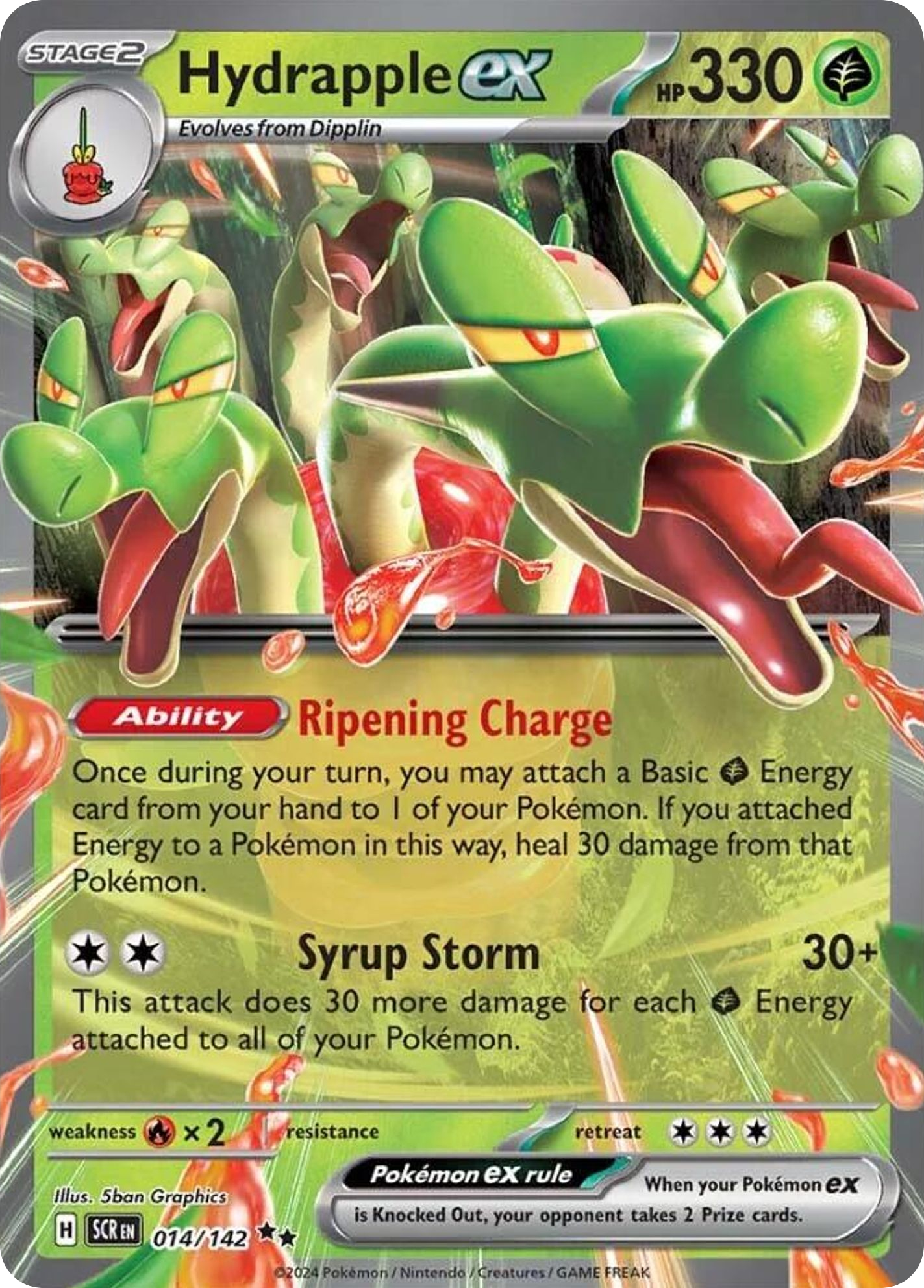
Hydrapple ex gives you a second way to take Prizes. "Syrup Storm" costs only two energy and does 30 more for each Grass Energy attached to all of your Pokémon. Energy you put on benched Ogerpon therefore adds to Hydrapple's damage without exposing anything. "Ripening Charge" attaches to any of your Pokémon and heals 30 from it, which keeps a damaged attacker alive or cancels Tapu Bulu's recoil.
Prizes come from these two attackers, plus Tapu Bulu as a non-ex option. Boss's Orders (2 copies in every list) picks targets off the Bench, and Briar can take an extra Prize with a Tera attacker when you are behind.
Key cards and counts
The typical list is very uniform. Across 164 lists with full composition data, the median is 21 Pokémon, 12 Items, 10 Supporters, 4 Stadiums, 13 Energy and 0 Tools.
The attackers and engine
- Teal Mask Ogerpon ex: 3.9 average, 100% inclusion. It is effectively a four-of. Every copy you have in play is another "Teal Dance" and another card drawn each turn. You want several on the board early, not one.
- Hydrapple ex: 2, 100%. Built through Applin (2, 78%) and Dipplin (2, 97.6%). Dipplin is only a step on the way to Hydrapple here.
- Meganium: 2, 100%, with Bayleef at 1.9 (94.5%). "Wild Growth" doesn't stack, so the second Meganium is a backup in case the first gets Knocked Out or prized. It is not extra output.

With Meganium in play, two Basic Grass Energy cards cover Ogerpon's Grass energy cost, Tapu Bulu's expensive attack and Meganium's own "Solar Beam". One card covers "Syrup Storm". Lists commit a Stage 2 line to this because it roughly halves how many attachments each attacker needs.
Getting set up

Forest of Vitality (3.6 average, 100%) is what lets two Stage 2 lines function. It lets Grass Pokémon evolve on the turn they are played (except on a player's first turn). You can drop Chikorita, Bayleef and Meganium in the same turn, or Applin into Dipplin into Hydrapple ex. Lists run nearly four copies because the deck stops working if the Stadium gets replaced, and a median of 4 Stadiums means Forest is often the only one in the list.
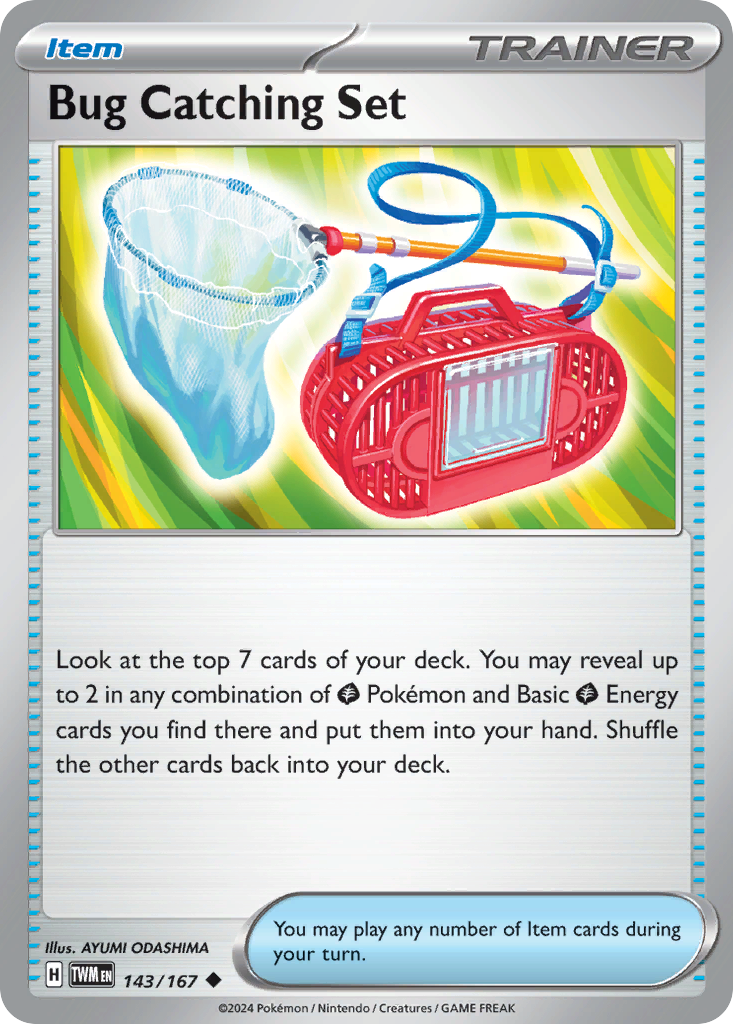
Bug Catching Set (4, 100%) looks at the top 7 cards and takes up to 2 Grass Pokémon or Basic Grass Energy. Almost every card in the deck qualifies, so it is one of the most reliable searches the list has. Ultra Ball (3.4, 99.4%) finds anything, including the ex Pokémon. Poké Pad (1.5, 92.1%) finds only Pokémon without a Rule Box, which here means the evolution pieces, Celebi and Tapu Bulu. Celebi (1.1, 90.2%) uses "Traverse Time" to grab up to 3 Grass Pokémon and Stadiums, which is how you find Forest plus the evolutions together.
Draw and recovery
Lillie's Determination is a locked 4 (100%). Meowth ex (1.6, 98.8%) searches out a Supporter through "Last-Ditch Catch" when benched from hand. Fezandipiti ex (1, 97.6%) and Unfair Stamp (1, 84.8%) both refill your hand after you lose a Pokémon. Night Stretcher (1.7, 97.6%) and Lana's Aid (1, 96.3%) bring back Energy and non-Rule Box Pokémon, so discarding Grass Energy to Ultra Ball costs very little.
Grass Energy shows 13 average copies at 72.6% inclusion. A Grass deck with no Grass Energy can't attack, so the figure is almost certainly a printing split in the aggregation, not lists skipping the card. The Energy median of 13 confirms the count.
Game plan
Early game
On your first turn, get Basics down: Teal Mask Ogerpon ex, Chikorita, Applin, and Celebi if you are going second and can attack. Forest of Vitality does not let you evolve on your first turn, so turn one is about bench width and a Stadium ready for the next turn. "Teal Dance" is live immediately, though. Attach from hand to every Ogerpon you have and take the draws. If you start with 6 Prizes, Lillie's Determination draws 8, which makes it the strongest early play in the deck (though the player going first can't play a Supporter on turn one).
"Traverse Time" from Celebi is the smoothest opener when going second. It can grab Forest of Vitality, Bayleef and Meganium in one attack.
Mid game
With Forest in play, evolve a full line in one turn. Meganium comes first when you can, because "Wild Growth" makes every later attachment worth double. Then build Hydrapple ex so "Ripening Charge" adds another attachment each turn.
Put Energy on benched Ogerpon too, not only the Active one. Benched Ogerpon take no damage from attacks, and every Grass Energy on them still counts toward "Syrup Storm". Choose between Ogerpon and Hydrapple as the attacker based on the Energy count: "Myriad Leaf Shower" rewards a loaded Active facing a loaded Active, and "Syrup Storm" rewards a wide spread of Energy across your board.
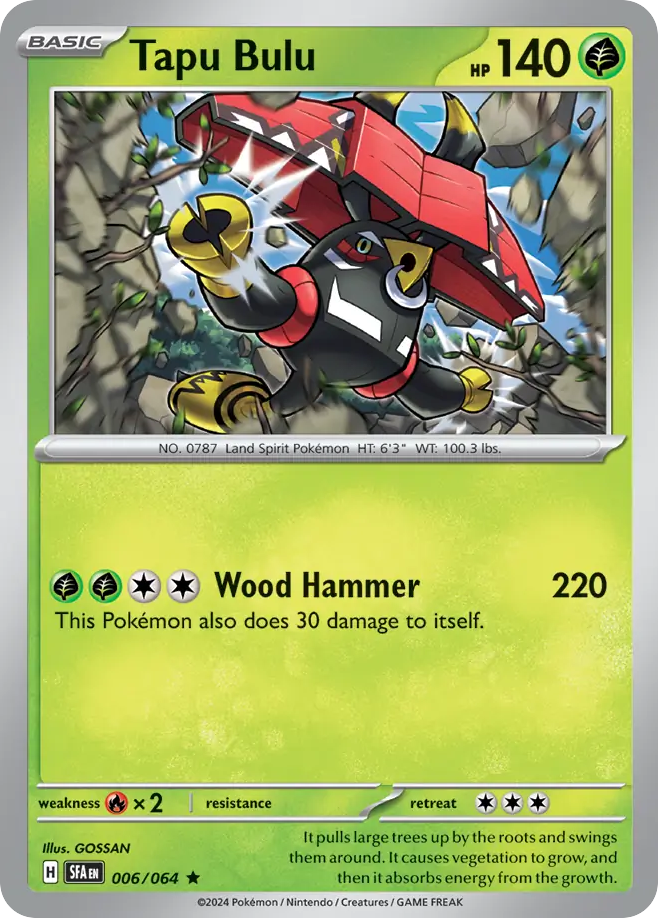
Tapu Bulu's "Wood Hammer" does 220 for four Energy worth of cost, which is two Basic Grass cards under "Wild Growth". It also does 30 to itself. Tapu Bulu is not a Pokémon ex, so trading it for a KO gives up only one Prize. Use "Ripening Charge" on it to heal the recoil. Its Retreat is 3, so plan the switch before you commit it to the Active Spot.
Late game
Once the opponent has taken a Knock Out, Fezandipiti ex's "Flip the Script" (draw 3) and Unfair Stamp (you draw 5, they draw 2) turn that loss into a refill and a disruption. Keep Boss's Orders for the turn that closes a Prize race: a benched Meganium or an evolving Stage 1 is often the right target.
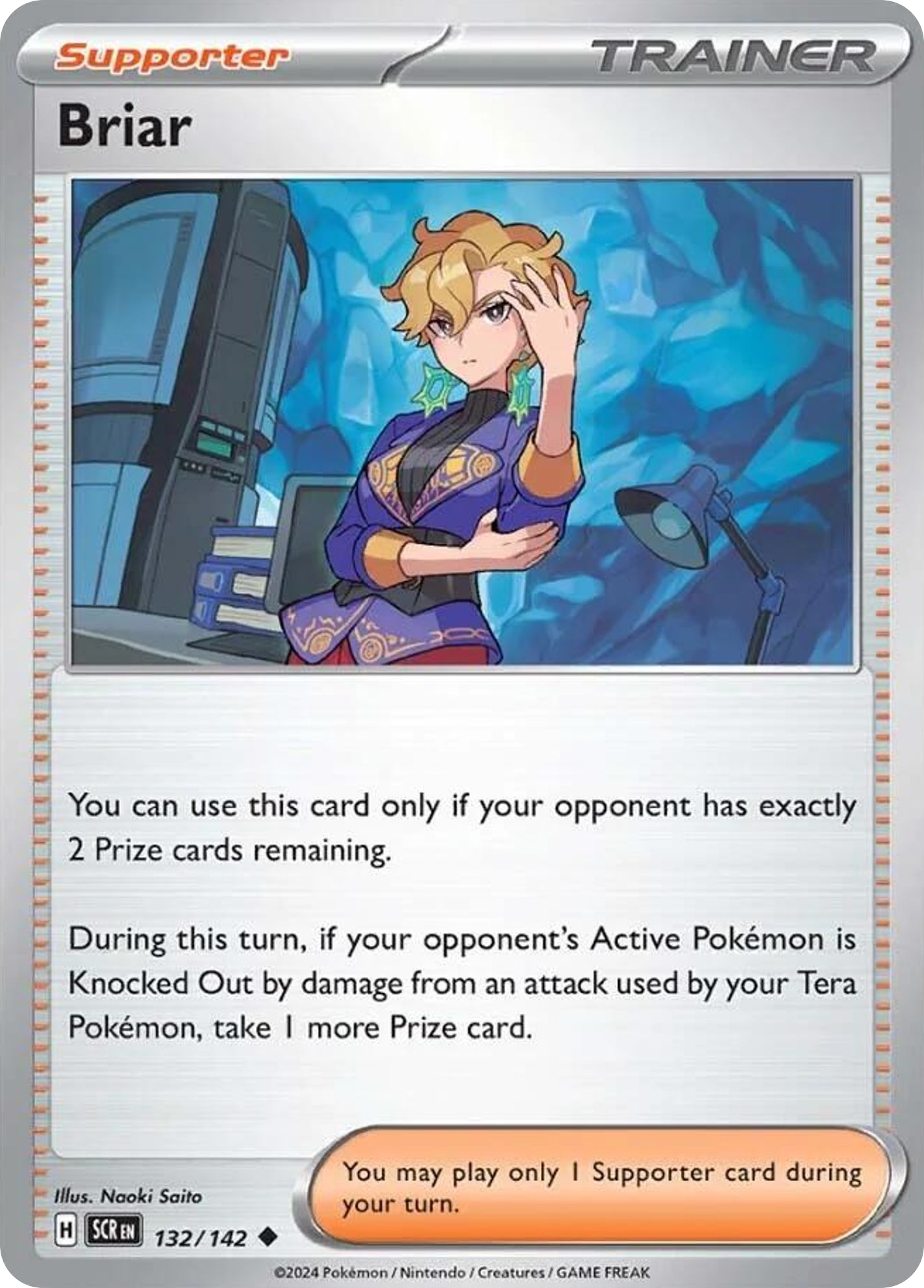
Briar is the comeback card. It works only if your opponent has exactly 2 Prizes left, and it gives you 1 extra Prize only when a Tera Pokémon's attack Knocks Out the Active. In this deck that means Teal Mask Ogerpon ex and "Myriad Leaf Shower". Hydrapple ex and Tapu Bulu don't qualify.
Matchups
The spread splits cleanly. The deck wins big against the Mega Kangaskhan decks and N's Zoroark, and loses to the Dragapult decks and Dipplin Thwackey.
| Opponent | Win rate | Games | Record |
|---|---|---|---|
| Dragapult Munkidori | 38.5% | 117 | 45-59-13 |
| Mega Kangaskhan Slowking | 58.9% | 56 | 33-16-7 |
| Mega Kangaskhan Meowth | 71.7% | 53 | 38-12-3 |
| Dragapult Dusknoir | 46.9% | 49 | 23-25-1 |
| Blaziken Dragapult | 45% | 40 | 18-21-1 |
| N's Zoroark | 67.5% | 40 | 27-9-4 |
| Dipplin Thwackey | 38.2% | 34 | 13-16-5 |
| Mega Excadrill Metagross (small sample) | 69% | 29 | 20-5-4 |
| Alakazam Dudunsparce (small sample) | 53.6% | 28 | 15-12-1 |
| Crustle Mega Kangaskhan (small sample) | 38.9% | 18 | 7-9-2 |
| Mega Lopunny Dusknoir (small sample) | 57.1% | 14 | 8-6-0 |
| Mega Lopunny Dudunsparce (small sample) | 57.1% | 14 | 8-5-1 |
The problem matchups
Dragapult Munkidori is the matchup that decides whether you bring this deck. It is the most played archetype at 16.9% usage, and at 38.5% over 117 games the result is not noise. The other two Dragapult builds are closer (46.9% into Dragapult Dusknoir, 45% into Blaziken Dragapult) but still losing. If you expect a Dragapult-heavy room, those three results together are the strongest argument against this deck.
Dipplin Thwackey (38.2% over 34 games) is the other clear loss. That list plays Dipplin, Bug Catching Set and Applin too, so it competes for similar resources. Keep in mind that Forest of Vitality works for each player's Grass Pokémon, not only yours.
Crustle Mega Kangaskhan also looks bad at 38.9%, but on 18 games that is a small sample. Treat it as unclear, not as a known loss.
The good matchups
Mega Kangaskhan Meowth (71.7% over 53) and N's Zoroark (67.5% over 40) are the best results with real samples behind them, and Mega Kangaskhan Slowking at 58.9% over 56 is solidly positive. Together those three decks make up a large share of the field below Dragapult Munkidori, and they are why the deck's overall win rate sits above 50% despite the Dragapult results.
Mega Excadrill Metagross at 69% looks excellent, but it comes from 29 games and is flagged as a small sample. The same goes for Alakazam Dudunsparce and both Mega Lopunny builds. Read them as leaning positive at most.
Every Pokémon in this list has Fire Weakness ×2. Against any attacker that exploits that, your damage math gets worse fast, so check the Weakness line on opposing attackers before you commit Energy to one Active.
Tech options
The core takes up most of the list, so flex slots are few. Lillie's Determination, Boss's Orders, Lana's Aid and usually Briar fill most of a median 10 Supporter slots. The flex choices mostly compete for the last one or two.
- Judge (1 copy, 69.5%). Each player shuffles their hand in and draws 4. It is the most common tech: disruption against a big opposing hand, and a reset for you when your own hand is stuck. What it costs you is a Supporter turn you could have spent on Boss's Orders or Lillie's Determination.
- Ciphermaniac's Codebreaking (1, 57.9%). Searches 2 cards and puts them on top of your deck in any order. It doesn't add to your hand this turn, so it works best when you have draw lined up for next turn, like "Teal Dance" draws, which then pull exactly the cards you set.
- Dawn (1.5, 53%). Searches a Basic, a Stage 1 and a Stage 2 in one card: a whole Chikorita, Bayleef, Meganium line, or Applin, Dipplin, Hydrapple ex. With Forest of Vitality in play, you can put that line into play the same turn. Lists that run it tend to lean less on Celebi or Poké Pad.
The partially adopted core cards are also where lists differ. Briar (81.1%), Tapu Bulu (87.8%) and Unfair Stamp (84.8%, the deck's ACE SPEC in most lists) are the usual cuts when a pilot wants room for more consistency.
Common mistakes
- Playing Forest of Vitality on turn one and expecting to evolve. The Stadium doesn't work on your first turn. Play it early anyway if you have nothing better to do, but plan your evolutions for turn two.
- Charging only the Active Ogerpon. "Teal Dance" attaches only to the Ogerpon using it, so each Ogerpon charges itself. That is fine: benched Ogerpon are protected from attack damage, and their Energy still counts for "Syrup Storm". Spread the Energy out.
- Leaving too many Rule Box Pokémon exposed. Meowth ex and Fezandipiti ex have no Tera protection on the Bench and give up 2 Prizes each. Bench Meowth ex when you need the Supporter, not by habit, and remember "Tuck Tail" can return it to your hand.
- Playing Briar with the wrong attacker. Briar's extra Prize applies only to Tera Pokémon, and only when your opponent is at exactly 2 Prizes. Hydrapple ex and Tapu Bulu don't qualify.
- Getting stuck in the Active Spot. Hydrapple ex and Tapu Bulu have Retreat 3, and Meganium and Bayleef have Retreat 2. Send a 1-Retreat Ogerpon or Celebi up front when you aren't attacking.
- Running a second Meganium into play for more output. "Wild Growth" doesn't stack. A second Meganium on the board is only insurance, and it costs Bench space.
FAQ
Is Hydrapple Teal Mask Ogerpon good in the current Standard meta?
It ranks 11th with 210 decklists, 2.9% usage and a 53.2% average win rate, and it has a 1st place finish in this window. Both usage and win rate are trending up. The weak spot is Dragapult Munkidori, the most played deck, where it wins only 38.5% over 117 games.
What are Hydrapple Ogerpon's worst matchups?
Dragapult Munkidori (38.5% over 117 games) and Dipplin Thwackey (38.2% over 34 games) are the clearest losses. Dragapult Dusknoir (46.9%) and Blaziken Dragapult (45%) are also losing. Crustle Mega Kangaskhan shows 38.9%, but that comes from only 18 games, so it is a small sample.
How many Grass Energy does Hydrapple Ogerpon play?
Lists average 13 Grass Energy, and the median Energy count across 164 lists is also 13. The high count feeds "Teal Dance", "Ripening Charge" and your manual attachment every turn, and "Syrup Storm" scales with Grass Energy on all your Pokémon.
Which ACE SPEC does Hydrapple Ogerpon use?
Unfair Stamp, at 1 copy in 84.8% of lists. It works only if one of your Pokémon was Knocked Out during your opponent's last turn. Then each player shuffles their hand into their deck, you draw 5 and your opponent draws 2.
Why does the deck play Meganium alongside Hydrapple ex?
Meganium (2 copies, 100% inclusion) has "Wild Growth", which makes every Basic Grass Energy provide double the Grass energy. That lets two Energy cards pay for Teal Mask Ogerpon ex's attack or Tapu Bulu's "Wood Hammer". Forest of Vitality, at 3.6 average copies, lets both Stage 2 lines evolve in one turn, which is why the deck can support both.
More guides
- 30th Celebration Set Review: The Cards To Watch · Set review
- Meowth ex Card Review: The Standard Supporter Tutor · Card review
- Baltimore Regional 1st Place - Mega Kangaskhan Meowth Decklist Profile · Decklist profile
- Dragapult Munkidori Deck Guide: Standard Counts, Plan and Matchups · Archetype guide